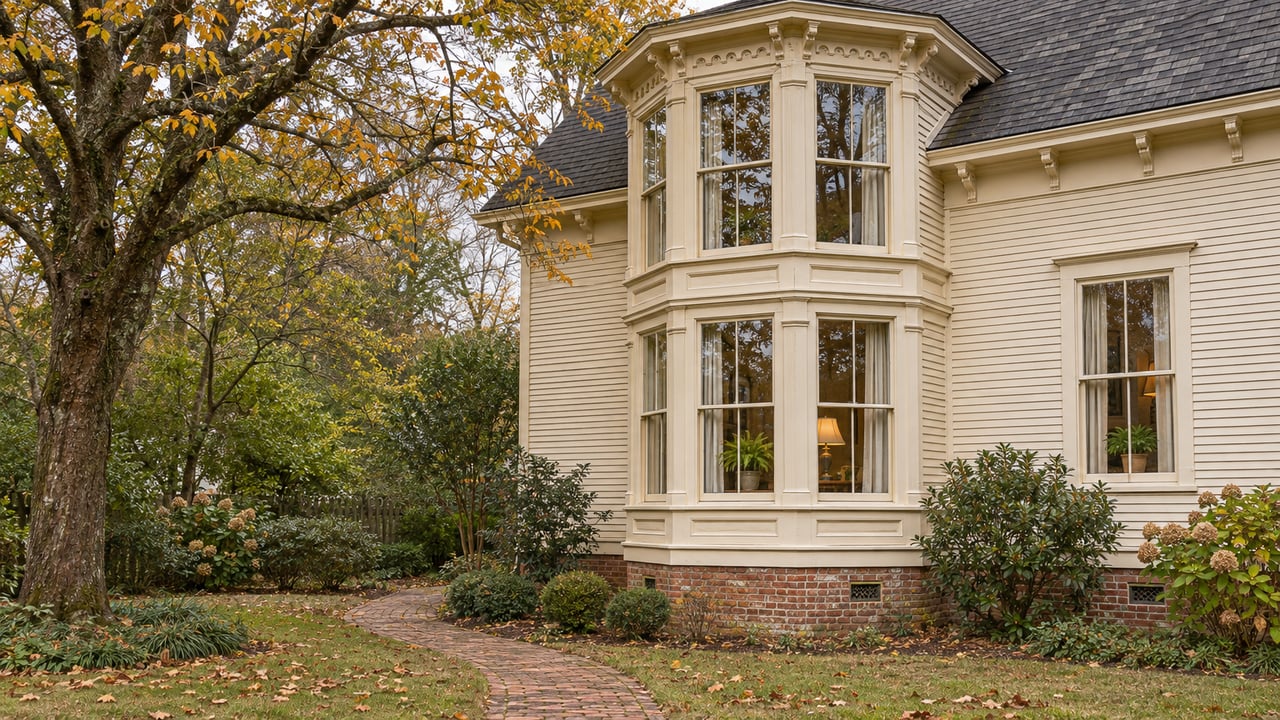
Florence's Historic Neighborhoods, Street by Street and Decade by Decade
On the 200 block of West Lelia Street, two houses stand a few doors apart, built a year apart. The Tomlinson Home at 233 West Lelia is a 1923 Prairie-style house. The Beck House at 229 West Lelia is a 1924 Neo-Georgian home. On Tuscaloosa Street, Thimbleton at 221 Tuscaloosa Street dates to around 1830. All three sit inside Florence historic districts, and a listing could call any of them a "historic home."
That label covers about a century of building. Florence has more than half a dozen historic districts that are mostly residential, and each was built in its own span of years. The district name tells you more about a house than the word "historic" does. If you know which era you want, whether Greek Revival, Queen Anne or a 1920s bungalow, you can narrow the map to a few streets before you open a single listing. This fall's Shoals market also gives buyers more time to search that way than they've had in recent years.
The City of Florence lists its historic districts on one page and links the register documents behind them. Alongside Downtown Florence and East Florence, the list includes Cherry Street, College Place, Locust Street, McFarland Heights, Sannoner, Seminary-O'Neal, Walnut Street, Wood Avenue and the Wilson Park Houses. Read in date order, the nominations work like a building timeline for the north side of town.
If you want a house from Florence's first decades, start with Sannoner. Its updated nomination describes the district along North Court and North Pine streets, from Tuscaloosa Street north to West Irvine Avenue and the University of North Alabama. Its documented houses date from 1825 through 1917. The nomination lists Federal, Greek Revival, Victorian, Gothic Revival, Colonial and Spanish Revival, Neoclassical, Craftsman bungalow and American Foursquare examples, and it says no single building type dominates.
Sannoner is the place to look for a house older than the Civil War, and it is also the district where neighbors are least alike. The nomination names Wakefield, Connor Place, the Irvine House, now Coby Hall, and the James Irvine House. It also names Courtview, the Greek Revival house now known as Rogers Hall. It identifies the Irvine House as Federal. The district was first listed on the National Register in 1976, and its nomination was updated in 2018.
Several very old houses sit just outside Sannoner on Tuscaloosa Street. Thimbleton, the circa-1830 house at 221 Tuscaloosa Street, is the oldest residence in the Locust Street district. A short walk east, the Wilson Park Houses district covers three houses at 209, 217 and 223 East Tuscaloosa Street, built between 1890 and 1918 in Victorian and Georgian Revival styles.
For a porch-wrapped Queen Anne or a late-1800s cottage, three parallel districts north of downtown have most of Florence's examples.
Walnut Street runs along North Walnut between Hermitage Drive and Tuscaloosa Street, and its houses date from 1889 to 1930. The nomination describes Victorian and Classical houses, Victorian and California-style cottages, and later Georgian Revival brick homes. Documented houses include the Queen Anne-influenced Howell-Jones House at 411 North Walnut, the McGee House at 424 North Walnut and the Scarborough-Wallace bungalow at 514 North Walnut. On one walk up the street, you pass from the 1890s into the 1920s.
Wood Avenue sits one street over and is the larger of the two. Its original nomination covers North Wood Avenue roughly between Tuscaloosa and Hawthorne streets, with listed properties on Hermitage Drive, Seminary Street and Hawthorne Street. The district counted 55 structures dating from around 1830, but most of its houses were built between 1880 and 1930. The Leftwich-Dillard-Mann and Reisman-Coffee-Looft houses show the Queen Anne influence, and the Sockwell and Ware-Wade houses are bungalows.
Cherry Street runs along North Cherry from just south of Hermitage Drive southeast to East Tombigbee Street. Its houses were built in waves in the late 1910s, the mid-1920s and the mid-1930s, and Queen Anne forms and bungalows dominate. The nomination singles out 511 North Cherry as an elaborate Queen Anne and dates most of the district's bungalows to 1920 through 1938. A buyer who likes Walnut Street but wants a slightly later house will find more of them on Cherry.
The early 20th century built a large share of Florence's older housing, and three districts concentrate it.
Seminary-O'Neal is the smallest and most consistent of the three. It covers houses on North Seminary Street and East Irvine Avenue, connects to Wood Avenue and reaches the edge of the UNA campus. Its 13 historic houses were built from 1908 to 1943, mostly bungalows, Sears "American Four-Square" houses and vernacular cottages. The Bower House at 517 North Seminary was ordered from Sears. The Walker Home at 513 North Seminary and Truda's Cottage at 214 East Irvine are also documented in the nomination.
Locust Street is the district to search for bungalows in quantity. It is bounded by Irvine Avenue on the north, West Mobile Street on the south, Cedar Street on the east and Locust Street on the west. Its nomination counts 85 bungalows, along with Victorian, Craftsman, Prairie, Foursquare, Tudor Revival and Colonial Revival houses. The James W. Nipper House at 302 Mobile Street is a documented Prairie-style residence, and the same district includes circa-1830 Thimbleton. Locust Street was added to the National Register in 2002, later than any other district on the city's list except McFarland Heights, which was added in 2017.
College Place, where this post started, covers the 700 to 900 blocks of Sherrod Avenue, the 200 block of West Lelia Street and nearby houses on West Mattie Lou Street and Circular Road. Its period of significance runs from 1907 to 1944. Craftsman and Revival styles appear there, but bungalows are the most common. The 1923 Tomlinson Home and the 1924 Beck House show how much variety one block can hold, even within a single decade.
Searching by era is slow because the houses that fit are few, and few of them are for sale at once. That's why the current supply numbers matter more to this buyer than the median price.
In September 2026, the Shoals area had 939 active listings, up 24.4% from September 2025, according to the Alabama Center for Real Estate's monthly report prepared with the Shoals Area Association of Realtors. Homes sold that month averaged 62 days on market, up 31.9% year over year. Supply in September 2026 stood at 5.0 months, against a September average of 2.7 months for 2021 through 2025. ACRE still places that 1.0 month below equilibrium and describes it as a transition in which sellers typically have more bargaining power.
For someone hoping a Cherry Street Queen Anne or a Seminary Street Foursquare comes up, that means more listings and more time to compare them than buyers had a few years ago. It does not mean sellers are making easy concessions. A buyer can tour Walnut Street and Wood Avenue on the same Saturday and come back the next week without as much pressure to decide on the spot.
The median is a weaker guide. ACRE put the Shoals-area median sale price at $265,050 in September 2026, down 0.4% from a year earlier, after an August 2026 median of $232,500. ACRE notes that the median rose 14.0% from August to September, compared with a typical September increase of 2.4%. These figures cover the whole Shoals area, not Florence or any single district, and a median that moves that far in one month says little about a 1920s bungalow in College Place or an antebellum house in Sannoner. For an older house, the district and the decade it was built make a better starting point than any area-wide average.
The Florence Historic Preservation Commission's page links the city's district list and posts a Bungalow Style Guide and an American Small House Style Guide, both good companions for a Saturday on College Place or Locust Street. The commission meets at 209 East Tuscaloosa Street, which is also one of the three addresses in the Wilson Park Houses district.
Which district has the most bungalows? Locust Street, by count. Its nomination identifies 85. College Place and Seminary-O'Neal are mostly bungalow streets too.
Where are the oldest houses? Sannoner, where documented houses begin in 1825, and along Tuscaloosa Street, where Thimbleton dates to around 1830.
How do these districts relate to downtown? Downtown Florence is its own historic district on the city's list, and the residential districts sit north of it, toward UNA. Our Downtown Florence Historic District page and Florence page cover the wider area.
Our founder, Matt Golley, has worked on historic renovations in downtown Florence, and we're happy to walk Wood Avenue or Sherrod Avenue with you before you choose a decade. If an 1830s house, a Queen Anne or a Sears Foursquare has caught your eye, Fernhill Realty - Shoals can help you sort through the streets and the listings at a comfortable pace. Contact us.
Shoals
Here's the full breakdown I walk every Florence, Killen, and Muscle Shoals seller through before we list.

Shoals
Choosing the right agent is one of the most important decisions you'll make when buying or selling.
Shoals
So instead of trying to predict the future, let's talk about what buyers should actually be paying attention to.
Helping you find your place in Alabama. We’re here to lift up the veil on homeownership and support buyers and sellers every step of the way, advocating for their best interests so they can enjoy the process knowing they’re in excellent hands!

FERNHILL REALTY SHOALS
1215 E Chisholm Rd Florence, AL 35630